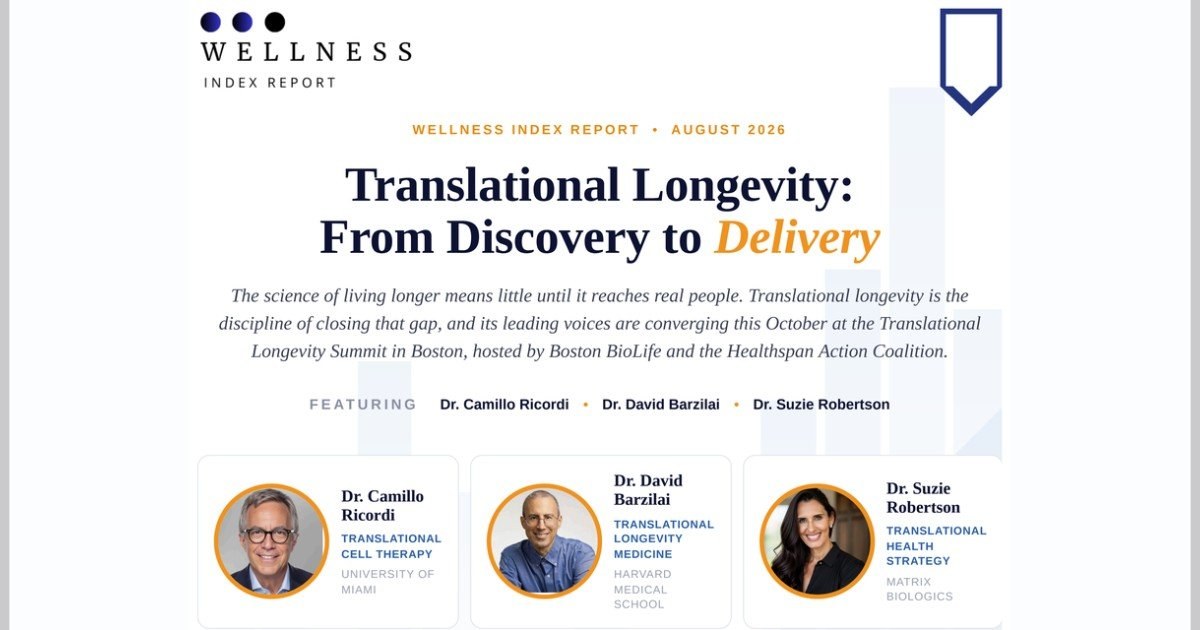
The August Wellness Index Report, published by Wellness Eternal, places a spotlight on translational longevity—the critical process of moving laboratory breakthroughs from the bench to the patient bedside. The report argues that the science of living longer means little until it reaches real people, and that translational longevity is where real progress is won. This focus matters because it addresses a persistent gap in biomedical research: many promising discoveries never become available treatments. By identifying translational longevity as the key discipline, the report signals a shift in the field toward practical delivery and patient impact.
The report identifies three defining signals for the field. First, cell science is shifting from proof of concept to real clinical delivery, meaning that cellular therapies are moving beyond early experiments into actual patient care. Second, evidence is emerging as the bridge from research to practice, highlighting the need for rigorous data to guide clinical decisions. Third, clinical strategy and systems are proving essential to scaling care safely and consistently, ensuring that new treatments can be delivered reliably to large populations. These signals collectively point to a maturation of the longevity field, where infrastructure and evidence become as important as discovery.
To advance this agenda, the Translational Longevity Summit will take place from October 7 to 11 at the Harvard Enterprise Research Campus in Boston. The summit is hosted by Joseph Krieger of Boston BioLife and Bernard Siegel of the Healthspan Action Coalition. Their involvement underscores the collaborative effort required to bridge the gap between research and clinical application. The event will bring together leading voices to discuss how to accelerate the translation of longevity science into therapies that can be delivered to patients. For those interested in the full announcement, including downloadable images and bios, click here.
The implications of this report and summit are significant for several reasons. First, they highlight that the longevity field is entering a new phase where the focus is not just on making discoveries but on ensuring those discoveries reach the clinic. This shift could lead to more rapid adoption of effective interventions and better patient outcomes. Second, the emphasis on evidence and clinical strategy suggests that the field is adopting a more rigorous, systems-oriented approach, which is essential for gaining regulatory approval and payer support. Third, the collaboration between organizations like Boston BioLife and the Healthspan Action Coalition demonstrates the kind of cross-sector partnership needed to overcome translational barriers. As the report notes, the Wellness Index Report is an independent, practitioner-led research platform that evaluates wellness providers, technologies, and protocols through expert nomination, customer feedback, clinical review, and ongoing rating analysis. This integrity-first standard helps identify solutions that are ready for real-world use.
For practitioners, companies, and innovators interested in being considered for future reports, participation is possible by completing the official submission and review process. The full August report is available at wellnessindexreport.com. As the longevity field continues to evolve, translational efforts will determine whether scientific advances truly benefit patients. The upcoming summit and the insights from the Wellness Index Report serve as a call to action for the entire ecosystem to prioritize delivery alongside discovery.