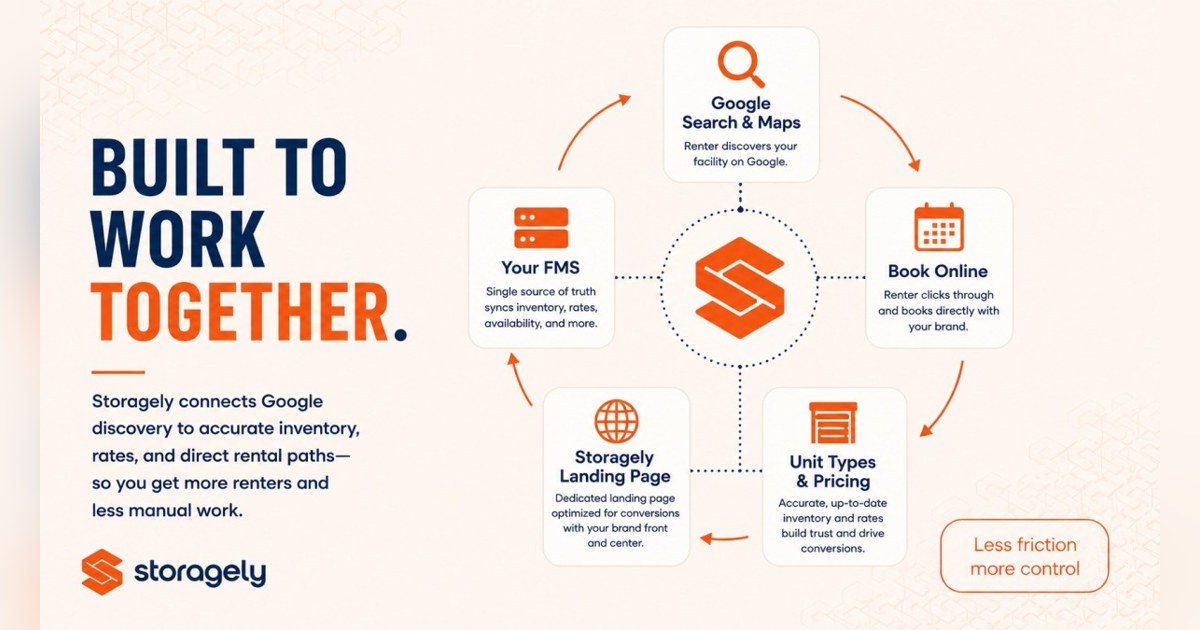
Storagely, a website and online rental platform built specifically for self storage, announced on September 2, 2026, that it has been approved for Reserve with Google, enabling the company to offer the integration to eligible customers. The move marks a significant shift in an industry where such capabilities have largely been limited to real estate investment trusts and a handful of the largest operators—companies with the scale and technical resources to build and maintain their own direct integrations with Google.
The approval means that eligible Storagely customers can now connect their locations, storage inventory, pricing, and rental experiences to Reserve with Google through the Storagely platform without having to independently develop and maintain the underlying integration. According to Austin Simmons, CEO of Storagely, the integration addresses a fundamental shift in how consumers find storage. "Google is already where an enormous number of storage searches begin," Simmons said. "Reserve with Google gives operators a more visible way to turn that search into action. Our job is to make the distance between someone searching for storage and becoming a tenant as short as possible."
One of the most immediate implications is visibility. In a traditional Google Search or Maps experience, a potential tenant may find a facility, interact with its Business Profile, visit its website, and then navigate through the site to locate available units. With Reserve with Google, eligible participating locations can display a distinct Book Online or Schedule action, offering consumers a prominent way to take the next step while they are actively searching on Google. "The Book Online button may look simple, but where it appears in the customer journey is incredibly important," Simmons said. "The customer is already looking for storage. We don't want to make them hunt for what to do next."
The integration is designed to go beyond simply adding a booking button. Storagely can publish a participating facility's available storage offerings, unit sizes, and current pricing directly to Google. Instead of Google only knowing that a storage facility exists, the integration can provide structured information about what that facility currently offers, including available storage unit types, unit sizes, climate-controlled and other storage options, current starting prices, and links into the appropriate online rental or reservation experience. Storagely is also designed to keep this information synchronized with the operator's current inventory and pricing, helping ensure the information provided to Google reflects what is actually available to rent. This is especially important in self storage, where inventory and pricing can change frequently. "Storage inventory and pricing are always changing," Simmons said. "The opportunity is to give Google a much better understanding of the storage options an operator offers, including sizes and pricing, rather than simply knowing where the facility is located."
Publishing inventory and pricing also creates the opportunity for a more relevant customer journey. Simmons compared it to searching for men's basketball shoes: if a consumer clicks a relevant result and lands on a page showing every type of shoe available, they have effectively been asked to start over. Self storage should work the same way, he argued. Someone interested in a 10x10 climate-controlled unit shouldn't have to land on a generic homepage and search through every available storage option again. The goal is to connect that customer as directly as possible to the relevant unit type, size, current price, and rental experience. "If the customer has already expressed what they're looking for, we shouldn't make them start over," Simmons said. "That's where this becomes much bigger than a booking button. It's about creating a direct connection between customer intent, current inventory and the storage option they're interested in."
The significance extends beyond the technology itself. Historically, sophisticated connections between Google, real-time storage inventory, and online rental platforms have been concentrated among operators with significant scale and internal development resources. Most independent and regional operators rely on their technology providers to make capabilities like this possible. Storagely's approval creates a new path for those operators. "You shouldn't need to own hundreds or thousands of facilities or maintain a large development team to compete for a customer who is ready to rent," Simmons said. "This gives more operators an opportunity to participate in a customer journey that has historically been concentrated among the biggest companies in the industry."
Storagely plans to begin making the capability available to eligible customers starting on September 14, 2026. Availability of Reserve with Google functionality, booking actions, inventory, pricing, and storage offerings is subject to Google eligibility requirements and Google's determination of how eligible actions and information are displayed across Google Search and Maps. Google ultimately determines when and how eligible inventory, pricing, and booking information is displayed across its products. For more information, visit Storagely.io.