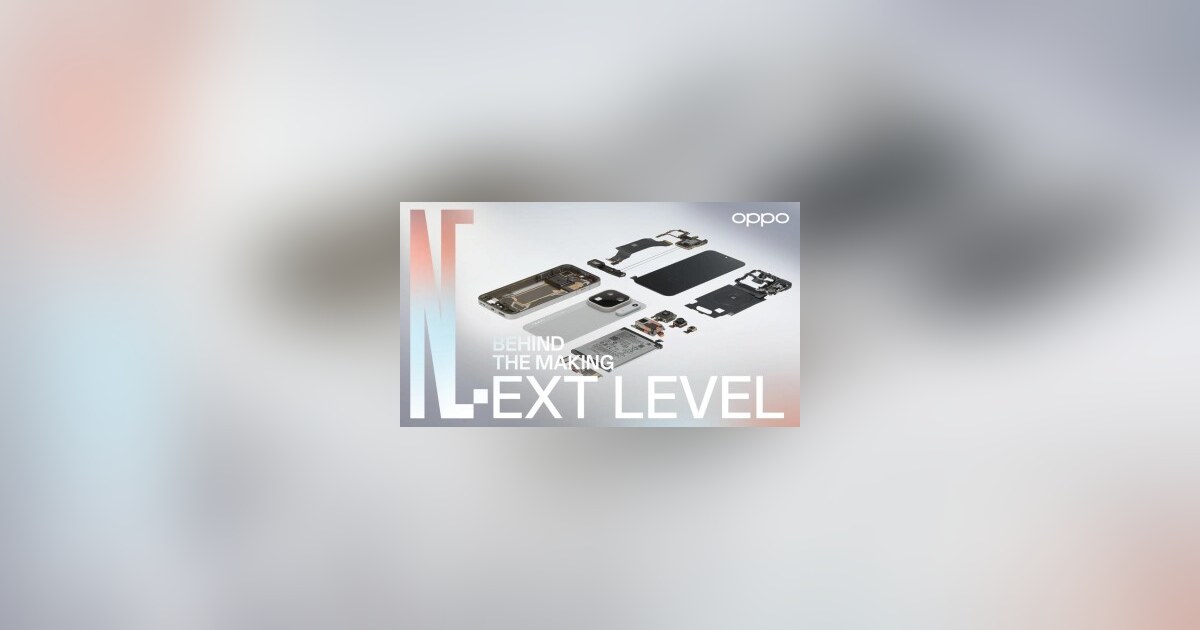
OPPO has offered media a closer look at the development, testing, and manufacturing processes behind its newly debuted Find X10 Series, framing the effort as the “Next Level of Making.” The initiative underscores how the company integrates product design, mobile imaging, artificial intelligence, and smart manufacturing to deliver consistent quality at global scale—an approach that matters as smartphone competition increasingly shifts from spec sheets to verifiable engineering rigor and user experience.
The Find X10 Series, which features an industry-first Triple 200MP Camera System on the Find X10 Pro Max, a next-generation LUMO True Image Engine, an all-new flagship design, and AI-powered ColorOS 17, was introduced globally before the media tour. According to OPPO, the tour demonstrated that each technology and feature is developed, tested, and verified through rigorous processes designed to ensure exceptional levels of quality and consistency across markets. The announcement was distributed via Media OutReach Newswire.
“Quality is the foundation of OPPO’s entire product portfolio, and our control over the product creation process is what allows us to realize this commitment at scale,” said Ling Liu, Overseas CMO of OPPO. “Last year, we introduced Apex Guard to show how our commitment to quality goes beyond everyday use, product lifespans, and industry standards. This year, we are opening up our development, testing, and manufacturing processes to unveil how that vision translates into the Next Level of Making, and ultimately elevates the products and experiences we deliver.”
The design story centers on OPPO’s Clean and Sophisticated language, exemplified by a One-Piece Sculpted Glass design in which the back cover gradually rises toward the camera area, creating a three-level transition that softens the camera’s visual impact. On the Luna White edition of the Find X10 Pro Max, a fluted texture along the camera module’s vertical edge nods to classic lens focus rings, while a two-tone woven pattern emerges subtly under light. OPPO says the Luna White colorway alone underwent over 40 rounds of fine-tuning, and a single rear-panel pattern requires more than 10 rounds of refinement across multi-stage precision treatments.
The camera system builds on OPPO’s co-development with Hasselblad that began in 2022, offering Master, Hi-Res, and Portrait modes. The LUMO True Image Engine operates across three architectures: Natural Tone for linear tonal rendering, True Color for accurate color via a 24-channel multispectral sensor, and Hyper Pixel for continuous 26MP output by default across main, telephoto, and ultra-wide cameras, with multi-frame fusion producing full-resolution 200MP photos in Hi-Res Mode. OPPO evaluates image quality against industry benchmarks and its own True-to-Life criteria, testing HDR, facial brightness, and skin-tone gradation across 40 lighting conditions and color reproduction against 140 colors rather than the standard 24-color chart. Real-world simulations include a dedicated concert stage setup and multi-axis robotic arms to assess stabilization.
On the AI front, ColorOS 17 brings system-level intelligence supported by a dedicated security framework. The AI Mind Pilot adds an Agent Mode powered by third-party AI agent Manus, operating on-device across photos and files to understand complex context and execute multi-step workflows. A new AI Photo Agent, backed by OPPO’s proprietary Visual-Language Model and six expert image models, interprets visual references and natural-language instructions to make edits users actually want. OPPO operates nine Internet Data Centers across six regions with 99.99% availability, and its Private Computing Cloud, developed with Google, isolates and protects user data processed in the cloud.
Manufacturing scale underpins the effort. OPPO operates nine smart manufacturing centers across China, India, Indonesia, Egypt, Turkey, Brazil, Pakistan, and Bangladesh, with over 95% of Surface Mount Technology lines and an average of 85% of final assembly lines fully automated. At the Chang’an Intelligent Manufacturing Center in China, more than 300 automated testing stations on final assembly lines help accelerate the path from innovation to high-quality production, shipping up to 7,200 finished Find X10 Pro Max devices daily. The implications are clear: OPPO is positioning vertical control over design, imaging science, AI infrastructure, and production as a differentiator that can sustain quality and reliability as it competes globally.