For years, businesses have been told to buy the best tool for each job and stitch them together. But according to idhubs, a company headquartered in McKinney, Texas, that approach is now a liability. In a recent interview with Justin Mackenzie of The Building Texas Show, idhubs Founder and CEO/CTO Rojit Sorokhaibam and Chief Growth Officer Brandon Fears explained why the integration model breaks under AI and how their platform aims to replace the traditional software stack.
The problem, as Fears described, is chaos that businesses did not choose. A company with fewer than 200 employees typically runs about 42 separate applications. A manager trying to convert a prospect, send an onboarding agreement, bill a deposit, and assign a kickoff task must touch five different apps. That means five logins, five sets of data that may not agree, and most of the day spent running software instead of the business. Sorokhaibam added that the industry sold this gap as a feature, calling it "best of breed," but it creates what idhubs calls context blindness.
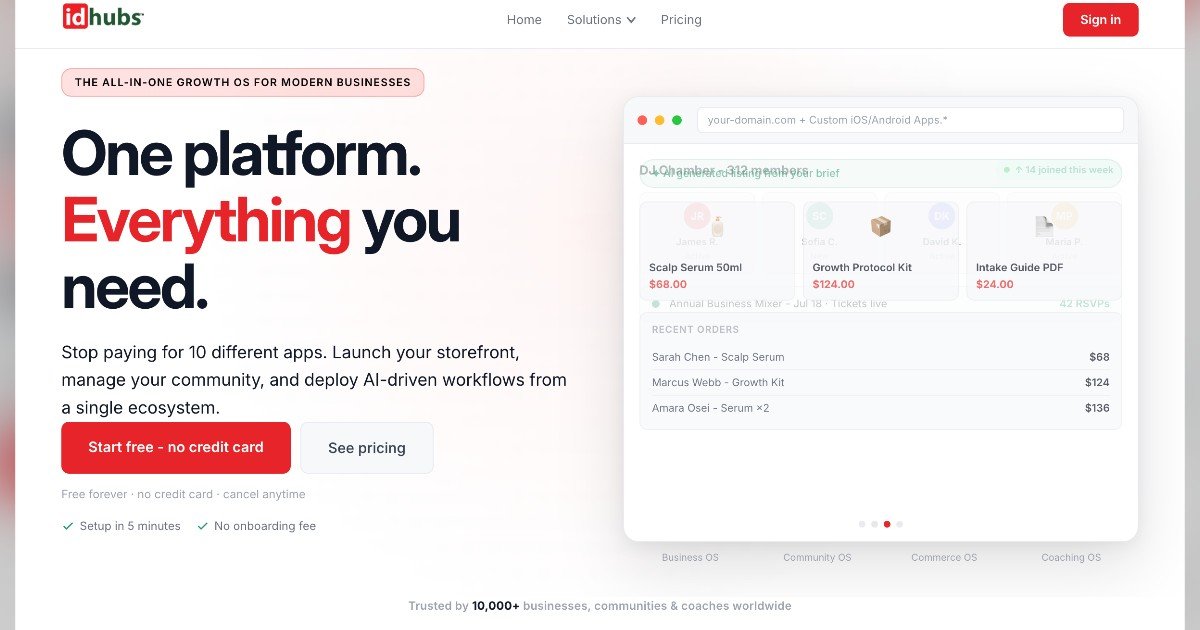
AI changes the stakes. When AI was just a chatbot, siloed data was an annoyance. But as AI becomes an agent that executes multi-step work, siloed data becomes a wall. An agent cannot intelligently complete a workflow if it must reach across five databases connected by brittle webhooks. True intelligence, Sorokhaibam said, needs one data foundation, and that cannot be bolted on after the fact. This is why idhubs built a natively unified operating system that includes CRM, e-commerce, community, invoicing, and AI on a single shared data layer. The company claims it is not another tool for the stack but a replacement for the stack.
The platform also offers a white-label community and social commerce layer. Because the front office and back office share the same database, organizations can deploy a branded ecosystem that includes internal collaboration and external community and commerce. This allows them to own their audience and data rather than renting it on third-party social platforms. A discussion can become a transaction or a support ticket without leaving the environment, creating a closed loop instead of disconnected ones.
Security is a critical concern for any unified platform, and idhubs addresses it with a permissioned, private Hyperledger Fabric network. Unlike public blockchains, this network uses channels and private data collections so sensitive records are visible only to authorized nodes. Heavy files are stored off-chain, while the ledger anchors state changes and audit trails asynchronously, so performance is not compromised. This provides enterprise-grade auditability and data sovereignty without the usual infrastructure costs.
The market opportunity is significant. idhubs reports a total addressable market of roughly $158 billion and has acquired more than 50,000 registered users organically, with no paid marketing. The leadership team includes three-time exited CTO Sorokhaibam, who scaled engineering teams of over 150 people, and Fears, who has launched more than $2 billion in products. Their advisory board includes Grant Johnson, former CEO of a NASDAQ-listed company, and Craig Kaufman of Kaufman Bros.
Pricing is designed to avoid what Fears calls a new "idhubs tax." The company killed per-seat pricing and instead charges a flat, predictable annual rate based on organizational capacity and transactional volume, not headcount. There are no hidden integration fees or per-API-call charges. Migration is another hurdle the company claims to have solved with automated pipelines for incumbents like HubSpot, QuickBooks, Salesforce, and Slack, running parallel environments to minimize disruption.
Competitors like Zoho, Odoo, and HubSpot also offer unified suites and are adding AI, but Sorokhaibam argues they were built as separate apps glued together, so their data layers remain fragmented. idhubs, by contrast, is natively unified from the ground up and includes enterprise-grade blockchain security that legacy SMB suites lack. For more information, visit idhubs.
The implication is clear: if idhubs is right, the era of buying best-of-breed tools and integrating them is over. In the AI era, context is the whole game, and businesses that rely on fragmented data risk falling behind. By offering a single, secure operating system, idhubs aims to eliminate the integration tax and free human capital for strategy instead of reconciliation.