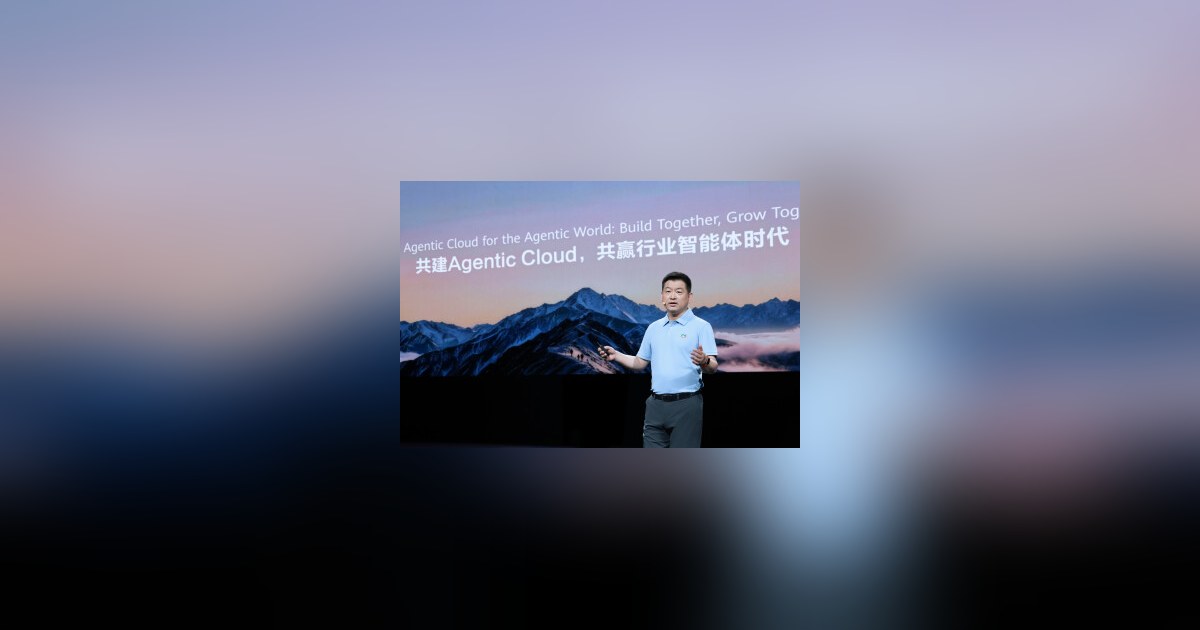
Huawei Cloud has announced the global rollout of its latest AI Cluster Service (AICS) and a suite of enterprise AI products, marking a significant step in its strategy to build an open agentic cloud. The announcements, made at HUAWEI CONNECT 2026 in Shanghai, underscore the company's ambition to provide the infrastructure and platforms necessary for the widespread adoption of AI agents in enterprises.
The new AICS, built on a five-level fast recovery mechanism, promises over 40 days of stable training on cloud and fault recovery within 10 minutes. It delivers 20% higher token throughput than the previous generation, a critical metric for AI training efficiency. The service will be commercially available in China on September 30 and in international markets on November 30. This global launch matters because it addresses a key bottleneck in AI development: the need for reliable, high-performance computing infrastructure that can handle the demands of increasingly complex AI models. By improving token throughput and reducing downtime, Huawei Cloud aims to lower the cost and barriers for enterprises seeking to develop and deploy AI agents.
Complementing the AICS is the Context Memory Storage (CMS) solution, designed for long-horizon agent tasks. CMS offers petabyte-scale memory space, twice the storage capacity of comparable products, and supports high-speed terabyte-scale reads with 50% higher performance. This is crucial for AI agents that need to retain context over extended interactions, enabling more sophisticated and useful applications.
Huawei Cloud also highlighted its Agentic Model as a Service (MaaS) platform, which aggregates diverse models, allowing developers to invoke state-of-the-art models from leading providers with one click. At the event, MiniMax demonstrated its advanced multimodal model integrated with Huawei Cloud. This approach simplifies access to cutting-edge AI capabilities, potentially accelerating innovation by reducing the need for enterprises to manage multiple model deployments.
The company's enterprise-grade agent platform, AgentArts, and its open-source edition, openJiuwen, have already served over 100 customers, including the Shenzhen Longgang District Government, China Southern Power Grid, and Kingsoft Office. The platform opens up more than 5,000 general Model Context Protocol (MCP) assets and over 1,000 industry-specific MCP assets. AgentArts will be commercially available outside China on December 30. The openJiuwen community has surpassed 50,000 stars and 3.29 million downloads, indicating strong developer interest. This dual commercial and open-source strategy could foster a broad ecosystem, similar to how open-source projects have driven adoption in other technology domains.
Furthermore, the Industry AI Foundry has accumulated over 1,000 industry assets and deployed more than 1,000 projects. Two new zones, Smart Government and AI Hardware, have been launched. The Smart Government Zone has 24 founding partners, while the AI Hardware Zone includes 15 core partners covering over 20 device types. By turning industry know-how into reusable capabilities, Huawei Cloud aims to accelerate AI adoption across sectors, from government services to consumer devices.
These announcements collectively position Huawei Cloud as a comprehensive provider of agentic AI solutions, from infrastructure to platforms to industry ecosystems. For enterprises, this means more options and potentially faster time-to-value for AI initiatives. For the cloud market, it signals intensifying competition, particularly in the race to provide the most robust and open AI infrastructure. As AI agents become more prevalent, the ability to develop, deploy, and manage them efficiently will be a key differentiator for cloud providers. Huawei Cloud's open approach, emphasizing collaboration with partners and open-source communities, could resonate with enterprises seeking flexibility and avoiding vendor lock-in. The global availability of these services will test Huawei Cloud's ability to compete outside China, where it faces established players like AWS, Microsoft Azure, and Google Cloud. For more information, visit HUAWEI CONNECT 2026 online.