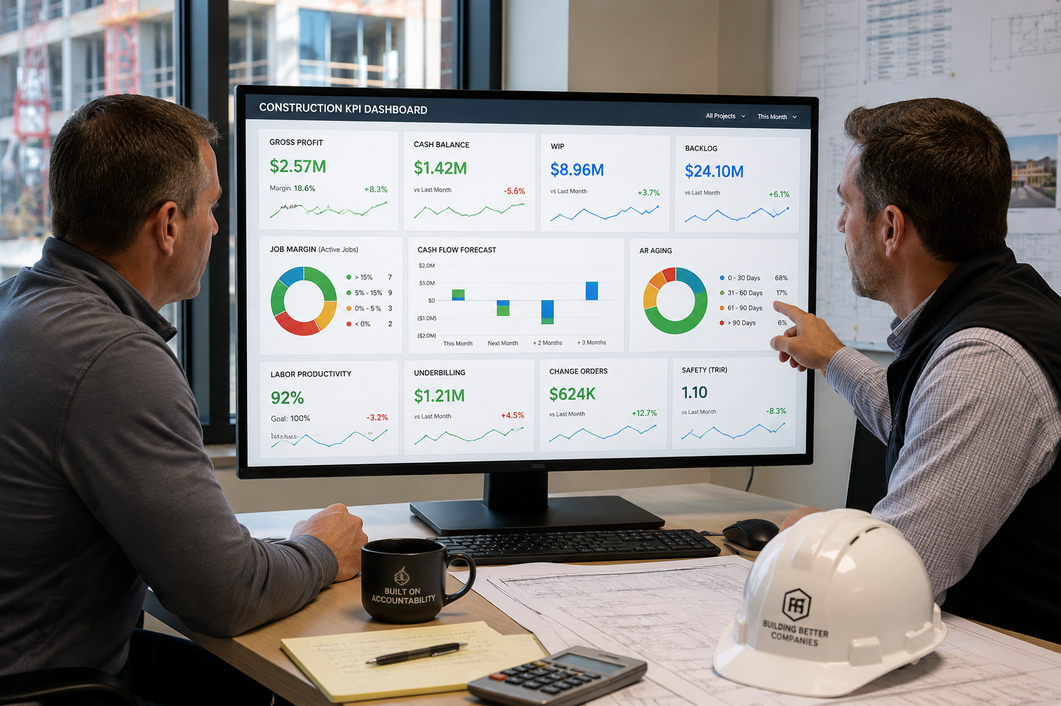
Daaxit, a provider of fractional CFO services for contractors, has published a new educational resource focused on construction key performance indicators (KPIs) and CFO accountability. The guide outlines how contractor leadership teams can use a defined scorecard to link company goals with measurable financial and operational results. This resource is designed for construction businesses that collect financial and project data but lack a consistent process for reviewing it, assigning responsibility, and acting on changes.
The scorecard organizes indicators into financial and job-level categories. Financial indicators include revenue, gross profit, gross-margin percentage, net profit, EBITDA, cash flow, accounts receivable, debt, and working capital. Job-level indicators cover estimated margin, current margin, labor productivity, work in progress, underbilling, overbilling, change orders, and cost to complete. Reviewing these metrics while projects are active provides leadership with a more current view than waiting until jobs are closed.
Cash flow is treated separately from reported profit, with measures like cash forecasts, receivables aging, retainage, payroll requirements, vendor obligations, debt payments, and billing position. These help explain why a profitable contractor might still face liquidity pressure. Backlog is also evaluated independently, considering expected margin, labor availability, project timing, customer payment terms, material exposure, and capacity.
"I don't believe in creating extra layers of reporting. That's why a scorecard should make responsibility clearer, reducing the need for more reporting," said Aaron Mills, Founder and CEO of Daaxit. "The purpose is to show what changed, who owns the result, and what action needs to follow during the next review cycle."
The guide recommends assigning an owner to each major KPI and reviewing results monthly. Financial indicators may be owned by the CFO, while labor productivity, change-order status, billing, collections, and project performance may involve operations, project management, accounting, or department leaders. Daaxit suggests tracking targets, current results, prior-period results, and required follow-up actions to identify trends and document responsibility.
Mills describes the process as a management routine rather than a one-time dashboard project. The value depends on consistent data, regular review, clear explanations of variances, and follow-through on assigned actions. The framework can be adapted for general contractors, builders, and specialty trades. Service contractors may emphasize technician productivity, dispatch performance, and fleet use, while project-based contractors may focus on work in progress, cost to complete, underbilling, retainage, and backlog margin.
The resource also addresses the need to separate performance by division, location, project type, estimator, project manager, or crew when detailed analysis is needed. This helps leadership determine where results are produced and where corrective action may be required. The full framework is available at Daaxit.