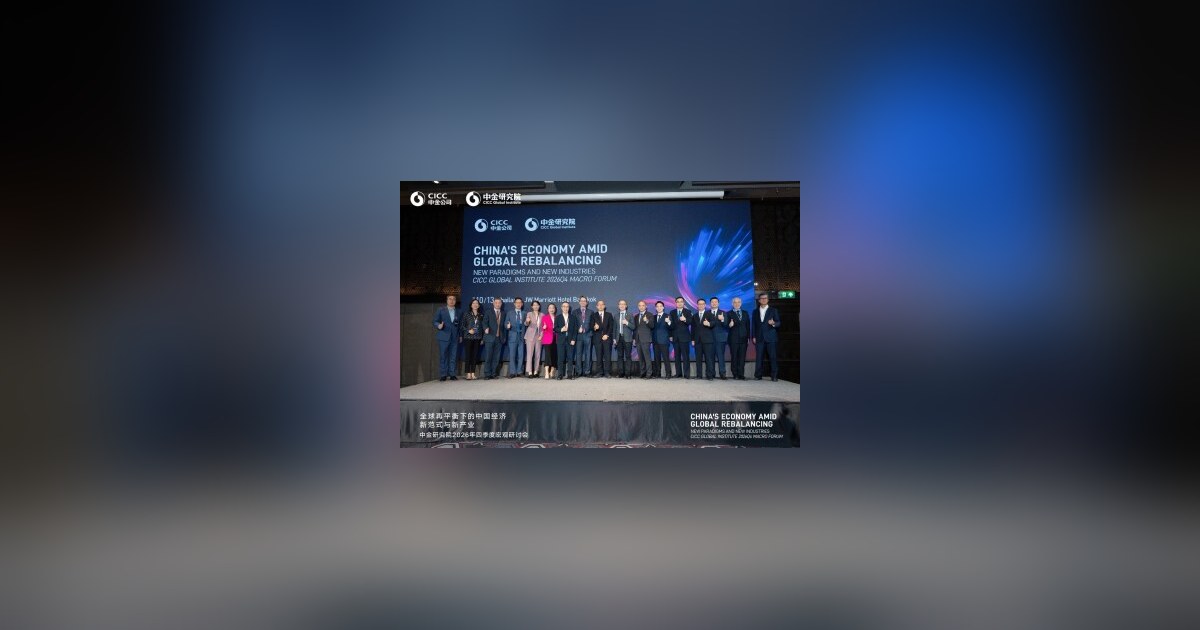
On October 13, the CICC Global Institute (CGI) convened its 2026 Q4 Macro Forum in Bangkok, Thailand, under the theme 'China's Economy amid Global Rebalancing: New Paradigms and New Industries.' The event, reported via Media OutReach Newswire, marked the first time the CGI Quarterly Macro Forum was held in Southeast Asia, signaling a deliberate push to internationalize discussions about China's economic trajectory. Its timing during the week of the IMF and World Bank Annual Meetings underscores an effort to insert Chinese perspectives into global conversations at a moment of heightened uncertainty about trade, investment, and monetary systems.
The forum's agenda reflects a broader rethinking of how China's economy is understood. Yanliang Miao, Chief Economist and Senior Managing Director of CICC, argued that grasping China's transformation requires a global rebalancing lens. He emphasized the dual dynamics of emerging industries and the transition from old to new growth engines, noting that this shift has profound implications for jobs, incomes, and demand. Miao also pointed to China's green and digital transitions, alongside a move toward a growth model underpinned by higher household incomes and services-led consumption. These observations matter because they suggest that China's economic evolution is not merely a domestic story but one that will reshape global demand patterns and investment flows.
Turning to the international monetary order, Miao observed that shifts in the global economy, trade networks, and financial technology are driving a more diversified international monetary system. He cautioned that economic and trade strength do not automatically confer international currency status; instead, institutional credibility and the depth and breadth of financial markets remain central. This has direct implications for the internationalization of the renminbi, implying that progress depends as much on domestic financial reforms as on trade volumes. For global investors, this signals that the pace of currency diversification will be gradual and contingent on institutional deepening.
Huimin Wu, Executive Dean of CGI and Deputy Head of Research Department at CICC, referenced the book 'The New Pattern of Dual Circulation,' jointly published this year by CGI and CICC Research Department. Wu noted that China's economy is entering a new stage, with trade and outward investment undergoing a paradigm shift and emerging industries becoming increasingly important drivers of global growth. These changes, she argued, are both part of and deeply shaped by global economic rebalancing, giving rise to a new pattern of interaction between China and the world. This framing is significant because it challenges simplistic decoupling narratives, suggesting instead a complex interdependence that will define future economic relations.
The forum gathered experts from the International Monetary Fund, the ASEAN+3 Macroeconomic Research Office, Shanghai Advanced Institute of Finance at Shanghai Jiao Tong University, National University of Singapore, ICBC Standard Bank, Wood Mackenzie, and NSQ Capital. Discussions covered transformations in China's trade and outward investment, as well as prospects for emerging industries such as innovative pharmaceuticals, green energy, and artificial intelligence. By bringing these voices together, the event aimed to foster a deeper understanding of China's economic transformation and contribute to mutual trust and consensus. As CGI continues to deepen its international engagement, such platforms could play a role in reducing information asymmetries and shaping global perceptions of China's economic direction.