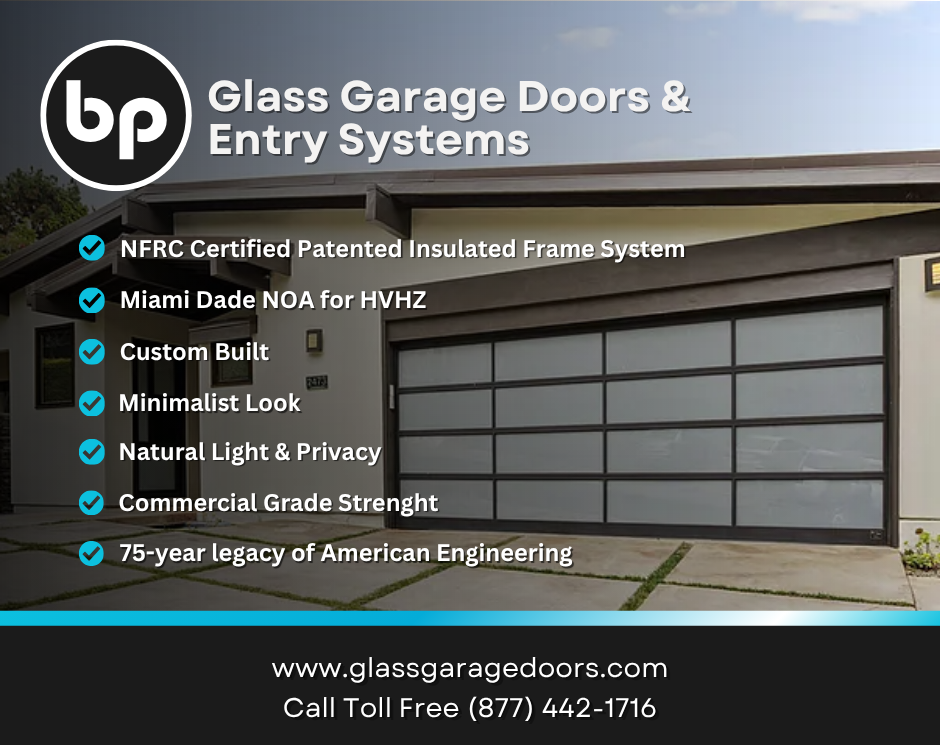
As the demand for seamless indoor-outdoor living spaces rises, architectural specifiers and property owners are increasingly drawn to frameless glass garage doors. However, a new technical advisory from bp Glass Garage Doors & Entry Systems warns that these adhesive-based systems may pose significant safety, structural, and code compliance risks, particularly in coastal and high-wind regions.
The advisory, issued by the Pomona, California-based manufacturer, points to the reliance on chemical adhesives, double-sided tapes, or caulking to bond heavy glass panels to hidden frames. Over time, thermal expansion, UV exposure, and weathering can degrade these bonds, leading to potential panel detachment and compromised building envelopes. "Adhesive-bonded frameless glass doors present a liability for commercial spaces and homeowners alike," said Rob Reyes, General Manager of bp Glass Garage Doors. "In an overhead application, relying on glue to support heavy glass panels over years of operation poses real dangers. Structural integrity must never be sacrificed for temporary visual trends."
The advisory outlines several technical limitations of frameless systems. To conceal interior framing, these doors typically require dark or mirrored glass, which can still show framework under nighttime lighting, undermining the seamless aesthetic. More critically, frameless configurations often lack verified thermal breaks and independent testing, causing failures to meet energy standards like California Title 24 and NFRC requirements. In coastal zones, particularly High-Velocity Hurricane Zones (HVHZ) such as Miami-Dade and Broward counties, the risks escalate dramatically. Accelerated adhesive degradation from salt air and UV, combined with zero wind-load and large missile impact resistance, can lead to catastrophic blowouts during storms. Moreover, these systems lack Florida Product Approval (FPA) and Miami-Dade County Notice of Acceptance (NOA), resulting in failed audits, denied insurance claims, and forced removal by authorities.
"Adhesive-bonded frameless glass doors present an unmitigated liability for commercial spaces and homeowners, particularly in hurricane-prone coastal regions like Florida," Reyes added. "In high-wind environments, relying on glue to hold heavy glass panels overhead is a severe hazard. True storm protection requires a high structural performance system that is mechanically anchored and impact-tested."
Service and maintenance also pose challenges, as proprietary or unverified hardware can complicate glass replacement and component sourcing. In contrast, bp Glass Garage Doors advocates for engineered precision with narrow frames that do not compromise safety. Their systems, backed by a 75-year manufacturing heritage, mechanically secure glass within custom frames and are independently tested and NFRC certified, making them suitable for live/work environments. The company emphasizes its factory-direct model and warranty as a testament to confidence in their products.
For architects and builders, this advisory underscores the importance of evaluating long-term safety and compliance over aesthetic trends. As building codes tighten and climate resilience becomes paramount, selecting mechanically anchored, certified systems may be essential to protect occupants and investments.